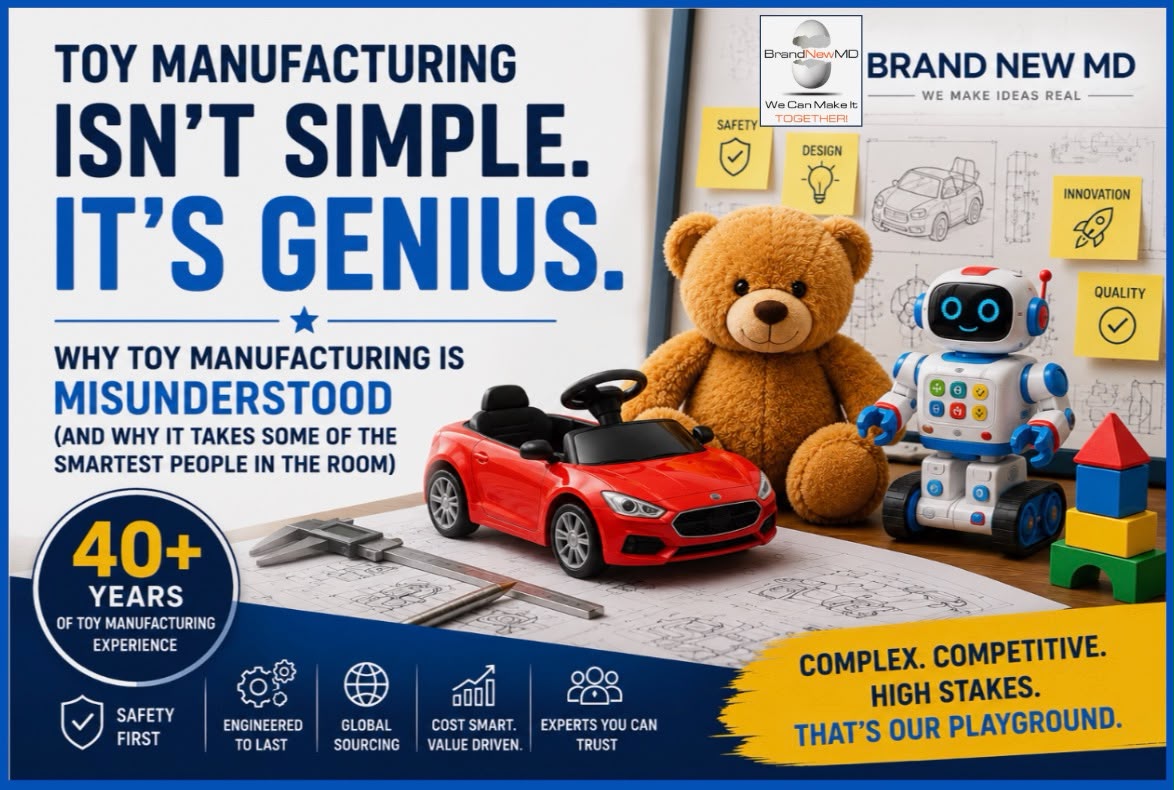
Toy manufacturing often doesn’t get the respect it deserves.
Mention aerospace manufacturing, automotive engineering, or medical device development, and people immediately recognize the technical expertise involved. Mention toy manufacturing, and some still picture a relatively simple process of producing colorful plastic products.
The reality couldn’t be more different.
Behind every successful toy is an extraordinarily complex combination of product development, industrial design, engineering, safety compliance, tooling, global sourcing, quality control, and supply chain management.
At Brand New MD, we’ve spent more than 40 years in toy manufacturing and product development. We’ve seen firsthand why developing a toy that is safe, durable, engaging, manufacturable, and commercially viable requires an exceptional level of expertise.
Toy manufacturing isn’t child’s play. Here’s why.
1. Toy Engineers Have to Understand Almost Everything
One of the fundamental drivers of play is emulation. Children want to interact with the world they see around them.
They want to drive cars, cook meals, operate tools, vacuum floors, build structures, and use the same types of products they see adults using.
That creates an unusual engineering challenge.
A toy product development company can’t specialize in only one type of product. Toy developers may need to understand elements of automotive design for a ride-on vehicle, appliance engineering for a working toy vacuum, electronics for an interactive learning product, and mechanical engineering for construction or agricultural toys.
The challenge is then taking those real-world functions and translating them into something smaller, simpler, safer, affordable, and fun.
Toy engineers are, by necessity, exceptional generalists.
2. Toy Safety Leaves Little Room for Error
There’s a misconception that products designed for children have less demanding manufacturing requirements. In reality, children’s products can face extremely stringent safety and compliance requirements.
Toy manufacturers must account for applicable standards and regulations such as ASTM F963, CPSIA, and EN 71, depending on the product and market.
Safety considerations can influence virtually every development decision, including:
Materials, coatings, paints, and components
Small parts and potential choking hazards
Pinch and entrapment points
Structural integrity
Product geometry
Battery and electronics design
Age grading
Manufacturing consistency
Safety can’t simply be addressed at the end of production. It needs to be considered throughout toy design, engineering, prototyping, material selection, and manufacturing.
A great toy isn’t merely fun. It must be engineered for the realities of how children actually use products.
3. Children May Be the Ultimate Product Stress Test
Adults generally understand that products have limits.
Young children don’t.
A toy might be dropped, thrown, stepped on, pulled apart, chewed, twisted, or repeatedly subjected to forces its designer never intended.
That means custom toy manufacturing requires engineers to anticipate unusually demanding real-world use.
Structural design, materials, fastening methods, internal components, and enclosures all need to work together to create products capable of handling expected use and foreseeable abuse while maintaining safety.
Age grading adds another layer of complexity. A product intended for a three-year-old presents different design considerations than one developed for an eight-year-old.
Successful toy development requires understanding both the product and the consumer using it.
4. Toy Manufacturers Engineer Innovation on Tight Budgets
Engineering a sophisticated product is one challenge.
Engineering it at a price consumers will actually pay is another.
Imagine incorporating electronics, sound, lights, sensors, moving components, or mechanical functions into a product destined for a mass-market retail shelf.
Every component matters.
Toy manufacturers must constantly balance:
Performance + Safety + Durability + Manufacturing Cost + Retail Price
That makes cost engineering one of the most important skills in toy development.
Tooling must be efficient. Components need to be sourced competitively. Assembly processes need to be streamlined. Materials need to meet performance and safety requirements without unnecessarily increasing costs.
The goal isn’t simply to make something cheaper. It’s to engineer the product intelligently so that the concept remains commercially viable without sacrificing quality or safety.
5. Toy Manufacturing Requires Exceptional Quality Control
A prototype working perfectly isn’t enough.
A successful toy manufacturer must be able to reproduce that same product consistently across thousands—or potentially hundreds of thousands—of units.
That requires rigorous attention to:
Tooling and mold design
Material consistency
Component sourcing
Assembly procedures
Factory quality control
Production inspections
Packaging
Testing
Shipping and logistics
The first production unit and the 100,000th unit should meet the same established quality expectations.
Achieving that consistency at scale is one of the defining challenges of professional manufacturing.
6. The Toy Industry Is Incredibly Competitive
Even after successfully designing and manufacturing a great product, another challenge remains: the marketplace.
The toy industry is crowded. Retail shelf space is limited. Consumer trends can change quickly. Seasonal deadlines are critical, and pricing competition can be intense.
That puts enormous pressure on the entire manufacturing process.
Tooling must maximize production efficiency. Global sourcing needs to remain competitive. Manufacturing schedules have to stay on track. Shipping windows need to align with important retail periods.
When margins are tight, seemingly small inefficiencies can become significant across tens of thousands of units.
That’s why experienced toy sourcing and manufacturing partners can make such a difference.
Experience Matters in Toy Product Development
Toy manufacturing deserves to be viewed as what it really is: a highly specialized discipline combining creativity with serious engineering and manufacturing expertise.
It requires industrial design, mechanical engineering, electronics, material science, safety knowledge, cost engineering, tooling expertise, quality assurance, global sourcing, and supply chain management.
And somehow, all of those disciplines have to come together to create something that feels incredibly simple to the end user:
A great toy.
That’s the beauty of the industry.
Looking for a Toy Manufacturing Partner?
At Brand New MD, we bring more than 40 years of toy manufacturing and product development experience to the table.
We help entrepreneurs, startups, established brands, retailers, and product companies navigate the journey from initial concept through development and manufacturing.
Our capabilities include toy product development, prototyping, engineering, custom toy manufacturing, factory sourcing, tooling, quality control, packaging, global sourcing, and production management.
We don’t simply connect clients with a factory. We work as a product development and manufacturing partner, helping solve the challenges that arise between a great idea and a successful finished product.
Because after four decades in this industry, we know something important:
Toy manufacturing isn’t simple. Doing it exceptionally well requires some of the smartest people in the room.
If you’re developing a new toy, children’s product, or complete toy line and need an experienced manufacturing partner to help bring it to life, contact Brand New MD to discuss your project.