For a startup founder, the birth of a product is emotional. It often begins with a eureka moment and a powerful drive to bring something into existence that did not exist before.
But after years of leading product development across multiple categories and helping bring 30 to 50 products to market each year, I’ve learned a hard truth: passion may spark the idea, but math builds the business.
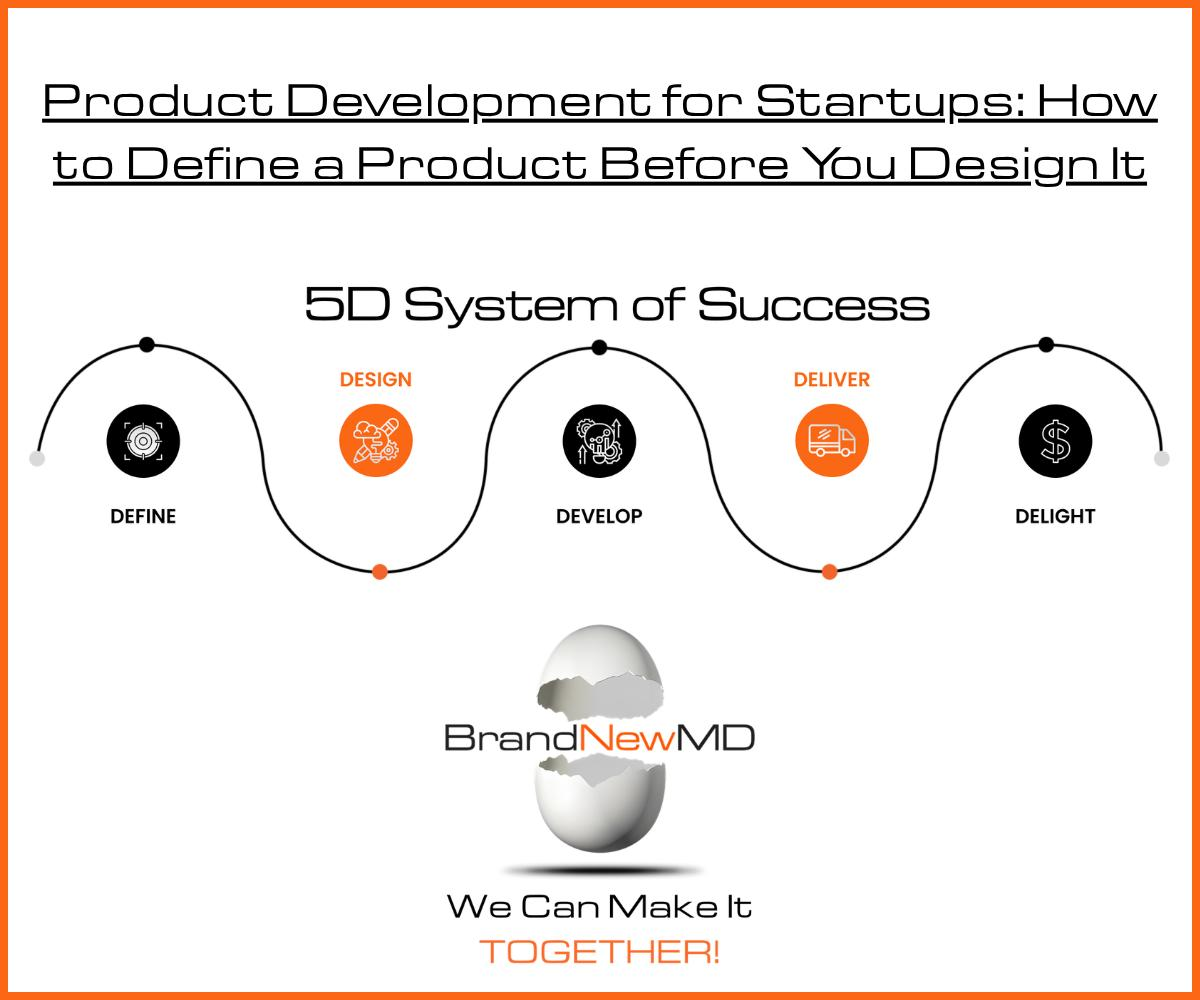
Established companies often develop products to protect existing shelf space. Startups, on the other hand, must develop products to win that shelf space in the first place. That is why the Define stage of the 5D System is so critical.
At Brand New MD, we believe the success of a product starts long before product design, sourcing, or manufacturing begins. It starts by clearly defining the product’s true reason to exist.
Here is how startup founders can define a product the right way before ever sketching a design.
1. Reverse Engineer the MSRP Before Product Design Begins
One of the most common mistakes in product development for startups is designing the product first, requesting a factory quote second, and then trying to figure out the retail price afterward.
That approach is backwards.
In the Define stage, the first question should be:
What will the consumer actually pay for this product?
Before you move into product design or manufacturing, you need to define:
• The ideal MSRP
• The customer’s value perception
• The target cost required to support healthy margins
If the market will only support a retail price of $29.99, but your features push your landed cost too high, you do not have a scalable business. You have a product idea with poor economics.
Strong product development starts by working backward from the market, not forward from your wish list.
2. Define the Product’s Unique Selling Proposition
A crowded market leaves no room for vague ideas. If you want your product to succeed, you must be able to explain its Unique Selling Proposition immediately.
If a buyer cannot understand why your product is different, the consumer will not either.
Your product’s reason to be may come from:
• A disruptive price point
• A patented feature
• A better size or material
• Improved functionality
• A texture, convenience, or performance advantage
If it is not clearly better, clearly different, or clearly more desirable, it becomes noise in the market.
At Brand New MD, this is one of the most important parts of the Define stage. Before product design and manufacturing begin, the product must have a sharp, clear position in the market.
3. Use Focus Groups to Pressure-Test the Idea Early
Many startups are built around one founder’s vision. That passion is important, but it can also create an echo chamber.
That is why focus groups matter.
In the early stages of product development, changes are relatively easy and affordable. You can still adjust features, materials, textures, packaging, and positioning before major costs are locked in.
As you move deeper into product design, prototyping, and manufacturing, changes become significantly more expensive and much harder to reverse.
This is why the Define stage is the best time to test your assumptions. Before the product becomes real, pressure-test the concept with real people. Learn what they value, what they do not understand, and what would make them buy.
Testing early saves money later.
4. Respect the Buyer’s Calendar and the Retail Timeline
Even the best product can fail if it arrives too late.
A strong product development strategy must include timing from the very beginning. That means understanding the buyer’s calendar, retailer open-to-buy windows, and key industry deadlines.
Ask yourself:
• Are you developing for a specific trade show?
• Do you need to hit a major seasonal retail window?
• Are you building for a buyer presentation on a fixed schedule?
A brilliant product delivered three months late can still be a commercial failure.
That said, not every product must rush toward an artificial deadline. If you are not tied to a retail calendar, the better philosophy may be:
Get it right, not right now.
At Brand New MD, we often tell founders that spending more time in the Define stage is far better than rushing a weak product into manufacturing just to meet a deadline that does not matter.
5. Define the Next Product Before the First One Launches
Many startup founders focus so intensely on the first product that they forget to think beyond it.
That is a mistake.
If your first product succeeds, retailers and consumers will immediately start asking what comes next. A variation. A refill. A premium version. A line extension. A new format.
In our experience, even strong products often have a lifecycle of just two to three years before the market shifts or competition catches up. If you have not thought about the next version while still defining the first, you risk losing momentum.
Smart product development is not just about launching one product. It is about building the foundation for a product line and long-term brand growth.
This is why Brand New MD helps founders think beyond the first SKU and define what future expansion can look like before manufacturing even begins.
The 5D Rule of Thumb: Spend Twice as Long in the Define Stage
The Define stage is where the smartest startup decisions are made.
It is also the one phase where mistakes are the least expensive to fix.
Once you move into product design, engineering, tooling, and manufacturing, every change becomes more expensive, slower, and more disruptive. But in the Define stage, you still have flexibility. You still have control. You still have the chance to get the fundamentals right.
That is why our rule of thumb is simple:
Spend twice as much time in the Define stage as you think you need.
At Brand New MD, we know that great product development is not just about creating something new. It is about creating something viable, differentiated, profitable, and ready to win in the market.
Because the products that succeed are not just the ones with the best ideas.
They are the ones that were defined correctly from the start.